
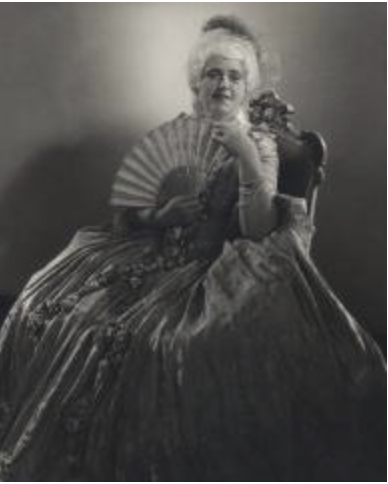
This page will attempt to bring together all the information that’s available on this website about Lehmann’s portrayal of the Marschallin in Der Rosenkavalier by Richard Strauss .
Since Lehmann is best known for that role it’s interesting to see where she sang the role and how often. The total number of performances is somewhere between 131 and 141, but that’s just the number that we can discover from the various sources at our disposal.
Here’s a breakdown: Though Lehmann had sung Octavian at the Vienna Opera, once she’d begun to perform the Marschallin at Covent Garden in 1924, she was in demand for that role in Vienna and ended up singing it 45 times there. The next most performances were 26 at the Met, then 23 with Covent Garden, 18 at the Salzburg Festival, 7 for the San Francisco Opera. Her final opera appearance was as the Marschallin in 1946 for the San Francisco Opera on tour in Los Angeles. There were four Marschallins in Chicago, two appearances in Paris, Berlin, and Hamburg. The other times that Lehmann sang the Marschallin were single performances in Cleveland, Philadelphia, Basel, and Graz.
Berlin offers the single greatest lapse in such numbers. There were three opera companies in that city during Lehmann’s time and there’s little authentic information about the various works performed or with which casts. That we only know of two is an obvious undercount, but there’s just no serious scholarship yet on this.
Lehmann on Der Rosenkavalier and the Marschallin in particular
From the Apple iBook, volume 2, but in website format, you’ll hear Lehmann sing excerpts from the role, speak about the whole opera, hear her in interviews about the role, and discover information on the 1933 recording.
You can experience my commentary for Lehmann’s recording of “Kann mich auch an ein Mädel erinnern” as well as her performance of this monolog.
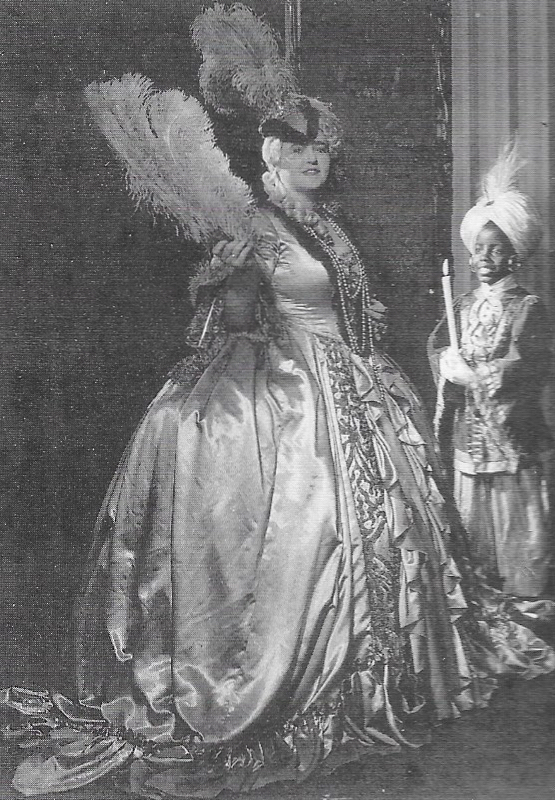
Photos of Lehmann as the Marschallin
Reviews of Lehmann in the role of the Marschallin
Daniele Palma has written a paper on Lehmann’s interpretation of the Marschallin.
Information on the 1933 recording of Der Rosenkavalier with Lehmann
(One can hear Lehmann’s portions of the 1933 HMV Rosenkavalier recording at: https://lottelehmannleague.org/the-lehmann-recordings/ Just scroll down to recording 212.)
Lehmann teaches the role of the Marschallin
“Live” 1939 radio broadcast of Der Rosenkavalier with Paul Jackson’s remarks
You can hear LL recite (not sing) the monolog from Act I ‘Die Zeit…’ https://lottelehmannleague.org/2022/volume-2-her-legendary-marschallin/
You may want to read magazine articles that may reference LL’s role in Der Rosenkavalier (use your search tool on the page). Or you can read about the famous recorded performances of the opera with Lehmann as the Marschallin. Finally, you can read Lehmann’s summary of the whole Der Rosenkavalier.
In her retirement, Lehmann painted tiles representing the whole Rosenkavalier story. You can view them here. They begin on number 35.
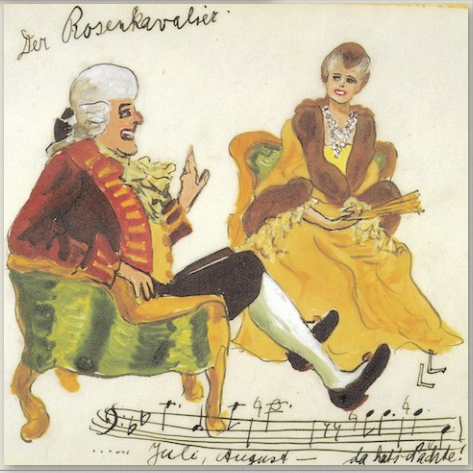
Was the Marschallin Lehmann’s favorite role? Here’s an early radio interview with her on that subject.
Conductor Maurice Abravanel on Lehmann’s Marschallin:
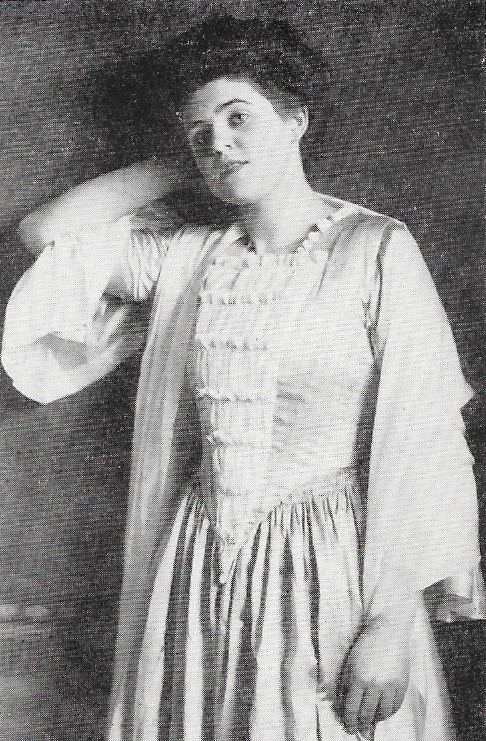
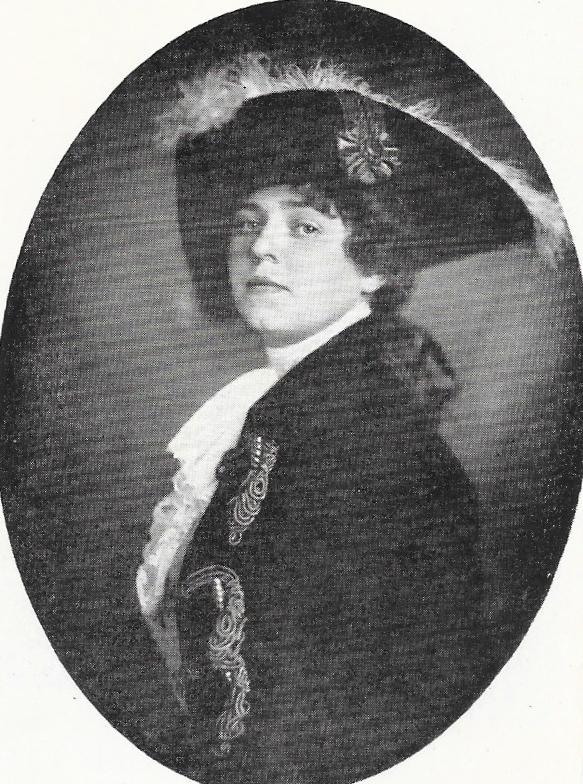
Here in her own words is an article by Judy Sutcliffe that shows her Lehmann connection through the role as the Marschallin.
P.S. The Marschallin in recital:
TIME Magazine Review
Music: More!
February 27, 1950
“One must take things lightly, holding and taking with a light heart and light hands—holding and letting go . . .”
These words of sage advice, sung to her mirror image by the aging Marschallin in Richard Strauss’s Der Rosenkavalier, are largely ignored by grand-opera stars. But to 61-year-old German-born Soprano Lotte Lehmann, who for 25 years sang them with unsurpassed eloquence, they have long had the weight of dogma.
Although her last singing of the Marschallin at the Metropolitan in 1945 brought her a 20-minute ovation, she decided soon afterward that it was time to “let go.” Two years ago she resolved to give up opera and operatic arias completely, sing only less strenuous lieder. She limited her concert tours to two months a year, spent the remaining ten months at her California home. When she wasn’t singing, she painted watercolors, fired ceramics of her own design in her home kiln, worked on her fifth book, Of Heaven, Hell and Hollywood.
Last week Lotte Lehmann, in the East for recitals and her first one-man show of paintings, went back on her resolution. To honor her good friend Richard Strauss, who died last summer (TIME, Sept. 19), and to mark her 50th Manhattan recital in a decade, she decided to sing once more the first-act monologues from her most famous role, the Marschallin.
To Lehmann fans the performance in Manhattan’s Town Hall had the air of a religious rite. They sat devout and mouse-quiet while the singer, dressed in sober black, her chestnut hair caught back in a plain bun, leaned gently against the curve of the piano. Without properties, costume or conspicuous gesture, Soprano Lehmann recreated the aging Viennese beauty with her oldtime fire and finesse.
For a minute after she sang her final words of wistful resignation, the audience was silent, then burst into seat-rattling applause. At intermission Lehmann had said, her eyes shining: “Fifty concerts! Aren’t you tired of me?” At recital’s end, the audience answered with cries of “More! More!” They brought her back for three encores.
By week’s end Lotte Lehmann had sung four sell-out recitals, closed her one-man painting show with most of her 63 paintings and ceramics sold. This week she was heading west for concert dates in Milwaukee and Chicago, then back home.
Schwarzkopf on LL’s Marschallin
An excerpt from the New York Times of 11 December 1960
ONE person who is glad she never saw Lotte Lehmann sing the Marschallin in “Der Rosenkavalier” is Elisabeth Schwarzkopf. The latter hastened to explain why she felt this way about one of the great interpretations of this century.
“Mme. Lehmann’s performance was so overwhelming,” Miss Schwarzkopf said, “that it dominated the thinking of anyone who saw it. Last fall, when I was singing with the San Francisco Opera, I visited Mme. Lehmann and talked to her about the role of the Marschallin. Many things she said will help me to deepen my present characterization.
“But it would be wrong for me to pattern my Marschallin after Mme, Lehmann’s, if only because my voice is much different from hers. It is higher and lighter and not so rich and solid in the middle register.”
Howard Taubman: NYT Review: 9 January 1943
“Der Rosenkavalier” is Richard Strauss’s warmest and most ingratiating opera. Though it has a bite, it also glows with tenderness and compassion. It makes an attractive evening in the theatre, as the Metropolitan Opera proved once again last night when “Der Rosenkavalier” was presented for the first time this season. The role of the Marschallin is one of the most acutely conceived characters in opera. It is almost nonoperatic in its psychological perception, and Strauss has written some of his finest pages for it. Lotte Lehmann has made this role her own. No one at the Metropolitan in recent years has brought to it her insight and humanity. As she sang the part last night it remained a mature and rounded character portrayal-in action and song. A pedantic mind could pick flaws in tones and phrases here and there, but these are beside the point in considering the refinement of her performance as a whole…..
Rosenkavalier Reviews from Fanfare Magazine
For any number of reasons, this could not be anyone’s only recording of Der Rosenkavalier. On the other hand, if this opera is in any way important to you, this is also not a recording that you should be without. Richard Caniell’s restoration of this 1939 broadcast surpasses all previous issues in quality, even including the Met’s own lavishly produced (and lavishly priced) LP set. The sound is fuller, the voices truer and more natural, the sonic grit minimized to a degree I would not have thought possible. Caniell has an approach to restoration that has stirred up some controversy on occasion, and it might do so here. Bodansky made a number of maddening cuts in Der Rosenkavalier, and one of them was so frustrating to Caniell that he edited in a few minutes of music from a 1946 Met broadcast. He never hides this—he is explicit in his notes: “…there is at least one major cut I cannot abide. This is his removal of over two minutes of music in Act III, the big moment when Ochs is surrounded by the children calling “Papa,” amidst great confusion (while a major waltz theme is heard fortissimo), and everyone goes off, leaving the Marschallin, Octavian and Sophie alone. I have interpolated this important passage from a later Met 1946 broadcast (with List as Ochs). Now, I no longer experience the shock I felt when I repeatedly heard this recording in previous years.” He has done a masterful engineering job, so the sound from the 1946 broadcast matches. Surprisingly, the performance even maintains its momentum and shape, despite the fact that it is George Szell conducting the 1946 fragment (I do wish Caniell had identified him in his notes). I too find this particular cut on Bodansky’s part infuriating, and I don’t mind this approach at all—but if you’re a purist, consider yourself warned.
Even with Caniell’s expert restoration, the sound of this broadcast is cramped and deficient in the full glory of Strauss’s orchestra. But it is now listenable to anyone with an ear attuned to “historic” recordings, in a way that it never has been. Beyond the sound and Bodansky’s cuts, the other reason that this should not be anyone’s sole Rosenkavalier recording is the actual conducting of Bodansky. He does bring energy and incisiveness to a score that can seem to drag, and he is sensitive to his singers. But there are times when the music would benefit from a somewhat more expansive approach. I am partial to the Solti/Crespin recording on Decca, though of course the Karajan/Schwarzkopf has many committed fans too.
So why can you not be without this? Primarily, but not solely, Lotte Lehmann in one of her greatest roles, caught in terrific voice and in a real performance. Her studio recording of most of the role for EMI in an abridged set (conducted decently enough by Robert Heger—reportedly EMI didn’t want to pay the fees asked by Strauss or Bruno Walter) is a classic, and has somewhat better sound. But here we have more of the role, and Lehmann motivated by the full theatrical experience of a stage performance. Her Marschallin is one of the truly great operatic characterizations, worthy of mention with Chaliapin’s Boris and Caruso’s Canio, and to have it in this form is to have a treasure. In addition we get the young Risë Stevens’s deftly characterized and beautifully sung Octavian, a relatively unknown Sophie in Marita Farell, but one who sings with the pure silver tone this music wants. Emanuel List was the Ochs of choice for many years, though I find that he slightly overdoes the boorish side of the character and his singing here is a bit rough. On the other hand, Friedrich Schorr as Faninal is luxurious casting in the extreme.
Caniell adds a bonus to the third disc: the final scene, pasted together from two different recordings. Frieder Weissmann conducts the scene that includes the great trio, and Meta Seinemeyer is exquisite as the Marschallin. Her voice sounds better here than on any other transfer I have heard of her. Then the final Octavian-Sophie duet is beautifully sung by Elfriede Marherr (Octavian) and Adele Kern (Sophie) with Julius Prüwer conducting. The join doesn’t quite work as well—the different voices and conducting work against it, but it is still a pleasure to hear these classic records from the late 1920s reproduced so well. Two interviews with Lehmann are included (after each of the first two acts), and we get some (but not all) of Milton Cross’s announcements.
This is a hugely important release to anyone who cares about this opera; even if you have the performance in an earlier incarnation, replacement is urgently recommended. Henry Fogel
Recorded in late September 1933, this collection of extended excerpts from Der Rosenkavalier is a celebrated landmark in the history of the phonograph, capturing, as it did, the artistry of the (then) three most celebrated current performers of their particular roles: Lotte Lehmann as the Marchallin, Elisabeth Schumann as Sophie, and Richard Mayr as Baron Ochs. It might have attained even more legendary status had Strauss himself conducted, but he reputedly wanted a fee that HMV was unwilling to pay. I attended a couple of Lotte Lehmann’s vocal seminars and, if there was anything she emphasized when coaching voice students, it was to get “inside” their roles. “Who are you? What has just happened? What do you think about it? Get your feelings into your singing—don’t just sing the notes” were constant admonitions of hers. In her book, Five Operas and Richard Strauss, she analyzes Der Rosenkavalier, Ariadne auf Naxos, Arabella, Intermezzo, and Die Frau ohne Schatten, with emphasis on the feelings of the leading characters and their interactions with each other. You can’t help but get some insight into the operas with her as your guide. She flavors her analyses with some interesting anecdotes. She was one of Strauss’s favorite singers. So she must be the “definitive” Marschallin, right? Not necessarily, for several subsequent Marschallins (who surely studied her recording) have staked a strong claim to the role and, possibly, even surpassed her, at least on records, namely Régine Crespin (Solti), Maria Reining (Kleiber), and Elisabeth Schwarzkopf (Karajan), all three of whom had the good fortune of appearing on outstanding complete recordings (or nearly complete, in Schwarzkopf’s case) but let’s deal with this 1933 group of selections, which constitutes about half of the opera (including all the “good” parts).
HMV’s choice for the conducting role was Robert Heger—not, perhaps, the most inspired collaborator for these singers, but he was working with the length of 78 sides and the need to not consume too many, so there are some little cuts within the big cuts (though they are smoothly managed) and some sections where he could have cut the singers a little more slack. HMV executives were probably familiar with him since he had been conducting at Covent Garden since 1925. Of all the conductors who have recorded the opera—Bernstein, Böhm, de Waart, Haitink, Karajan, Kempe, Kleiber, Krauss, Solti, and Vonk—his is, arguably, the least distinguished name, certainly the least well-known, but he had a long career. I heard him conduct in Germany in 1960 and he ended up living to be 91, dying in 1978.
The collection begins with the prelude and continues until shortly after the entrance of Baron Ochs. Then we hear some of the byplay between Ochs and the Marschallin. After this, the music starts up again after Ochs has exited and continues to the end of act I. The selections from act II begin as Octavian approaches the Faninal mansion and continues through the presentation of the silver rose and the conversation between Octavian and Sophie. We then skip to the brief little love duet between them and then skip again to the closing moments of the act as Ochs contemplates his marriage and is invited to an assignation with “Mariandel.” In act III, we get the bustling prelude and some of the scene between Ochs and “Mariandel,” followed by a big chunk of the last part of the act where the humiliated Baron flees the chaos at the inn, leaving the stage to Octavian and Sophie. The Marschallin’s closing words, “Ja, Ja,” had to be sung by Schumann because Lehmann, for whatever reason, had already left the recording session. Aside from that odd lapse, Lehmann is pretty much all she was touted to be, catching the Marschallin’s patient affection for Octavian and her polite contempt for the boorish Baron Ochs and any other nuance you’d like to hear. Never the possessor of a ravishingly beautiful voice, she was near her vocal prime at the time of the recording. Earlier in her career, she had sung Sophie and Octavian before “graduating” to the Marschallin.
As for Mayr, he’s the best Baron Ochs I have ever heard or ever expect to hear because of, believe it or not, his charm. As Lehmann put it in her book, “Mayr actually transformed the Baron into a boorish character, a boozy, dilapidated spendthrift who no one could really hate because he was so pathetically funny at heart. His was an inimitable, a onetime portrait that simply cannot be copied. No one is irreplaceable, and Baron Ochs has been sung by many others successfully, credibly, and with superb effectiveness; but to me the inimitable personal note with which Mayr managed to endow the figure of Ochs has been missing ever since and I never sang the Marschallin later on without being sadly reminded of Richard Mayr.” Strauss once said that he composed the role with Mayr in mind, though he did not sing at the Dresden premiere. Elisabeth Schumann is in good voice and soars through her performance as Sophie with considerable aplomb, but I don’t find her superior to all her recorded successors, among whom I especially admire Helen Donath (Solti), Hilde Gueden (Kleiber), and Rita Streich (Böhm). Maria Olszewska’s Octavian doesn’t always sound as if she’s thinking, “Who are you? What has just happened? What do you think about it?” Or maybe her voice was not made to suggest such nuances. She’s certainly highly qualified as far as the notes go but, to get a more vivid reading of Octavian’s sentiments, one can turn to Christa Ludwig (Karajan), Yvonne Minton (Solti), and Sena Jurinac (Kleiber), just for starters. Like the complete Rosenkavaliers, this one has a good supporting cast.
This opera has done pretty well on recordings. Leaving broadcasts aside, a studio recording of Der Rosenkavalier is not undertaken lightly: You need a very good conductor, a virtuoso orchestra, outstanding soloists (if only because of the competition) and a strong supporting cast, and thanks to some of the stereo recordings that came along, a good recording crew. Most of the studio recordings have risen to the challenge. I would recommend Solti’s as the best all-around performance and recording but Karajan’s EMI has vivid dramatic interplay between Schwarzkopf and Ludwig, good early stereo sound, the Philharmonia Orchestra (and a few theater cuts). Although recorded just before stereo came in, Kleiber’s has outstanding sonics and a strong cast. All three conductors, for all their virtuoso brilliance, are sympathetic accompanists. I might nitpick at the recordings of Bernstein (but he ravishes the score), de Waart, Haitink, and the Karajan remake, but less for their own faults than for the strength of the competition—they are good performances by almost any standard. I think that the Böhm (his DG studio version), Kempe, Kraus, and Vonk recordings have more conspicuous vocal weaknesses. Until the latest advance in 78 resuscitation comes along, I guess anyone who wants to sample the great Rosenkavalier cast of the ’30s should be content with what Pristine Audio has accomplished. James Miller
Here’s another reissue of this venerable recording, presumably to celebrate its fiftieth anniversary. The performance was recorded in September 1933 and has been studied (one assumes) with profit by several generations of Strauss singers. Elisabeth Schumann (Sophie) and Richard Mayr (Ochs) began singing their roles in 1911, shortly after the world premiere; in fact, Strauss had hoped to have Mayr create the part of the lecherous Baron. Lehmann, after singing Sophie and Octavian early in her career, became the world’s most celebrated Marschallin—she also wrote an informative book about certain Strauss operas that should be required reading for singers.
I’ve heard that EMI had hoped to have the composer himself lead the recording but settled for Robert Heger when Strauss demanded more money than the company was willing to pay in those economically depressed times. Economics may also account for the fact that the recording, originally issued on 26 78-rpm sides, was heavily cut. Although Heger was a first-class workman, the presence of the composer would have given this recording more documentary value, if nothing else, and I must emphasize that documentary value iE the principal virtue this set has going for it—as a performance of Der Rosenkavalier, per Se, it frustrates as much as it satisfies because of all the jarring cuts. It’s still a valuable link to a great tradition, but anyone who’s looking for a complete Rosenkavalier should look elsewhere, preferably in the direction of Solti.
Lehmann’s Marschallin is justly renowned but she sounds a bit old even though she was only 45 at the time of the recording, and I’ll have to say that I don’tthink she gets as much out of the role as Crespin and Schwarzkopf do… and now I might as well make a clean breast of it and confess that I have found other Sophies just as sweet and silvery-voiced as Schumann’s and many Octavians (almost all of them, in fact) superior to Olszewska’s. Mayr’s Ochs remains an incomparably good-natured rogue—he must have been marvelous in person. Most of the “Ochsen“ I’ve heard are so boorish that they make the opera a trial to sit through.
The sound of this EMI reissue is the best Heger’s Rosenkavalier has ever received even if it can’t match the stereo spectaculars of later years, but even if it were complete, there’s a strong possibility that I’d prefer Solti’s, and possibly those of Kleiber, Karajan, and Bernstein as well. But if you’re determined to have this one, I’d suggest the Seraphim reissue, which contains some interesting Lotte Lehmann material as a bonus.
James Miller